
Quick facts
Wildlife
Spitzkoppe's rocky environment supports rock hyrax (dassie), Klipspringer, leopard (present but rarely seen), chacma baboon and a range of desert birds including rock kestrel, Namibian rock agama lizard and various raptors nesting in the cliff faces. The Verreaux's eagle has been recorded here. The surrounding Namib gravel plains support oryx, springbok, ostrich and the occasional bat-eared fox. At night, the absence of light pollution makes Spitzkoppe one of Namibia's finest stargazing locations, with the Milky Way visible to the naked eye year-round.
Top activities
Sunrise photography from the Spitzkoppe campsite — the peaks catch first light in shades of orange and gold. San Bushman rock art site — guided walk to the painted cave (Bushman's Paradise) with red ochre figures. Natural arch walk (Bushman's Arch) — a large granite arch accessible on a 45-minute trail. Rock climbing on the granite faces — multiple established routes for experienced climbers. Stargazing and night photography — minimal light pollution makes this one of southern Africa's finest night sky destinations. The Pool (natural rock pool) — hike to a water-collecting rock basin used by wildlife. Camping inside the conservancy managed by the local Damara community.
About Spitzkoppe
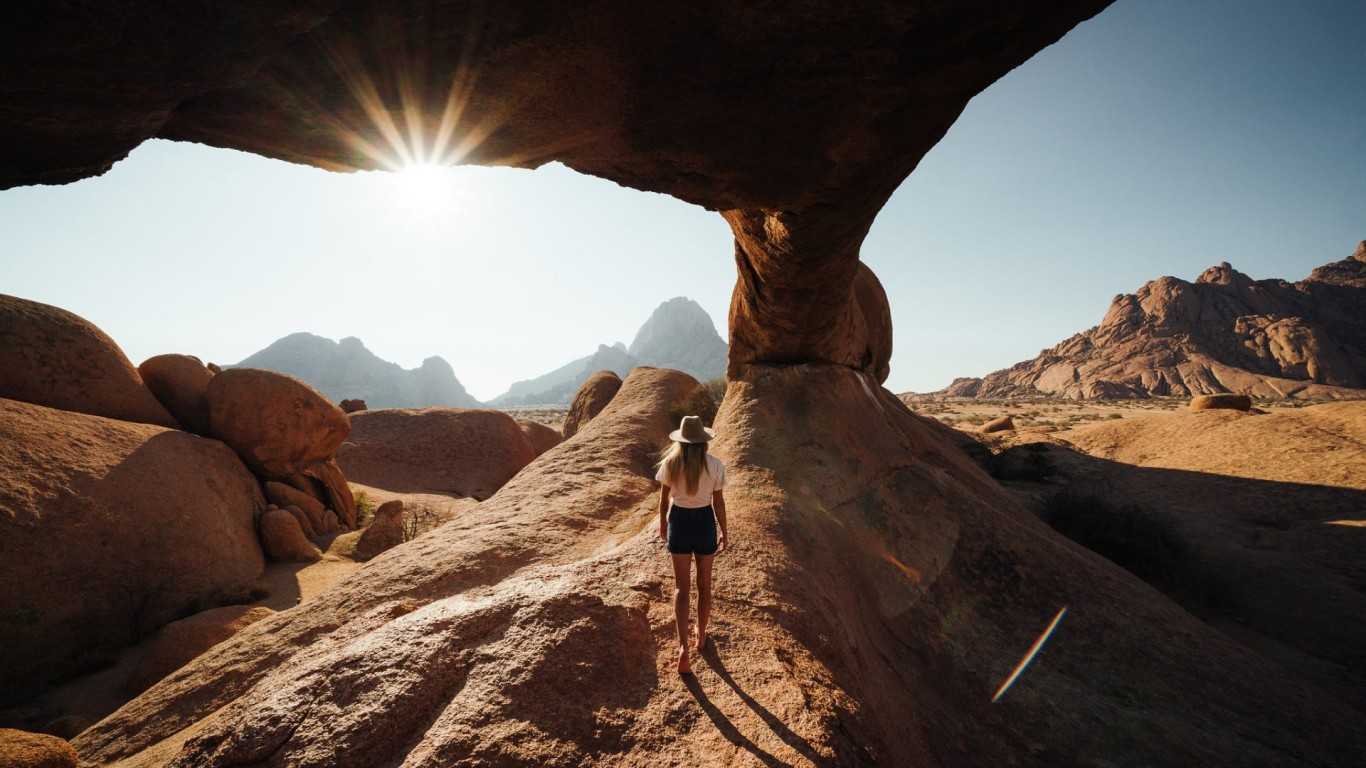
Rising 700 metres above the Namib gravel plains on a dead-flat horizon, the Spitzkoppe inselbergs have been there for 120 million years — the exposed cores of ancient volcanoes whose surrounding rock eroded away over geological time, leaving only the resistant granite boss standing. The Damara people call them Pondoks, meaning “huts.” Early European settlers, seeing a profile that reminded them of the Swiss Alps, called them the “Matterhorn of Namibia.” Both names describe a landscape that is genuinely other-worldly: polished boulders the size of houses, arches worn through solid granite, and a sky so devoid of light pollution that the Milky Way casts a shadow on clear nights.
Spitzkoppe is not a national park. It is managed by the local Damara community as a conservancy, and the camping fee goes directly to the community. This management model has kept the site more intimate and less developed than a formal park — campsites are individual clearings among the boulders, with fire pits and no electricity, and a single path to the painted cave.
Where is Spitzkoppe?
The inselbergs are in the Namib Plains of Namibia’s Erongo Region, approximately 170 km northeast of Swakopmund and 290 km northwest of Windhoek. The turnoff from the C36 road is 24 km of good gravel to the conservancy gate.
The San Bushman rock art
Inside the main Spitzkoppe massif, the Bushman’s Paradise cave contains a well-preserved gallery of San rock art — red ochre animal and human figures painted on the overhanging rock face, some of which may be several thousand years old. A local conservancy guide accompanies all visitors to the site (included in the camping/day visitor fee) and explains the iconography and the San people’s historical relationship with the landscape.
Bushman’s Arch
A 45-minute trail from the campsite leads to the Bushman’s Arch — a large natural granite arch worn through the cliff face by millennia of wind erosion. The arch frames a view of the plains beyond in the classic landscape photography composition; sunrise visits are most productive for the quality of the directional light.
Camping and stargazing
Camping at Spitzkoppe is one of Namibia’s great outdoor experiences. The conservancy has individual sites positioned among the boulders — some with natural rock overhangs, all with fire pits and clear sky views. The light pollution is essentially zero; the Milky Way is visible to the naked eye from around 20:00. The combination of the granite silhouettes and the night sky has made Spitzkoppe one of the most visited locations for astrophotography in southern Africa.
Combine Spitzkoppe with…
- Swakopmund — 2 hours west; the natural combination with the Namib coast.
- Twyfelfontein — 3 hours north; the great Namibian rock art comparison.
- Etosha — 4–5 hours north; the Namibia safari circuit.
Frequently asked questions about Spitzkoppe
Can you climb the main Spitzkoppe peak?
The main peak (1,784 m asl) requires technical rock climbing skills and is not accessible to general visitors. The surrounding formations, including the Groot Spitzkoppe, have established routes for experienced climbers; permits and guides are managed through the conservancy.
Do you need a 4WD for Spitzkoppe?
The 24 km gravel road from the C36 is manageable in a 2WD sedan with care. Inside the conservancy, the main camping areas are accessible by 2WD; some peripheral sites benefit from ground clearance.
How long should you spend at Spitzkoppe?
One night is the minimum to properly experience the sunset, the stars and the sunrise. Two nights allows for the full trail circuit, the rock art and extended stargazing.
Want to visit Spitzkoppe?
Get a free custom safari plan within 24 hours.
Spitzkoppe safari tours
No fixed packages listed yet — we'll build a custom safari around Spitzkoppe for you.
Plan My Trip Browse All ToursWant to visit Spitzkoppe?
Get a free custom safari plan within 24 hours.
Best time to visit Spitzkoppe
May to October — Dry season / winter (clearest skies, best photography)
The dry winter months give Spitzkoppe its most spectacular skies — the absence of summer moisture means near-zero cloud cover at night, and sunrise photography of the granite peaks in clear light is at its finest. Temperatures are comfortable during the day (22–30°C) with cold nights (5–10°C at altitude). The winter Milky Way, rising over the Spitzkoppe silhouette, is one of southern Africa’s great astro-photography shots.
November to April — Summer (greener, stormy skies, dramatic light)
The Namib Plains receive some rain from November–March. The surrounding landscape greens briefly after rain, providing photographic contrast against the grey granite. Afternoon thunderstorm clouds build dramatically behind the Spitzkoppe peaks. Summer temperatures can reach 38–42°C in the plains — arrive for sunrise and leave before midday.
Bottom line: May to October for the finest photography and stargazing conditions. Year-round for the geological spectacle itself.
Where to stay in Spitzkoppe
We'll recommend accommodation across all budget levels based on your dates and preferences.
Plan My Trip Browse All LodgesWant to visit Spitzkoppe?
Get a free custom safari plan within 24 hours.
Nearby destinations
 Namibia
 Namibia
 Namibia
 Namibia
 Namibia