
Quick facts
Wildlife
The Dyer Island and Geyser Rock area near Gansbaai (Shark Alley) supports the world's highest recorded density of great white sharks, attracted by the 60,000-strong Cape fur seal colony on Geyser Rock. Great whites are present year-round but are most active April to October. African penguin colony at Dyer Island is visible on the boat trip. Southern right whale calves in Walker Bay nearby from June to December. Cape fur seal, African gannet, black-browed albatross and various storm petrel species are also encountered offshore.
Top activities
Shark cage diving (no certification required) — suspended surface cage allowing non-divers to view great whites underwater from the safety of the cage. Shark scuba diving (certification required) — deeper cage experience for qualified divers. Shark viewing from the boat deck — excellent for photography without getting wet. African penguin colony observation at Dyer Island. Southern right whale watching from Hermanus (20 km east) combination. Shark education briefing on board — natural history and conservation context from trained marine biologists.
About Cage Dive with Great White Sharks
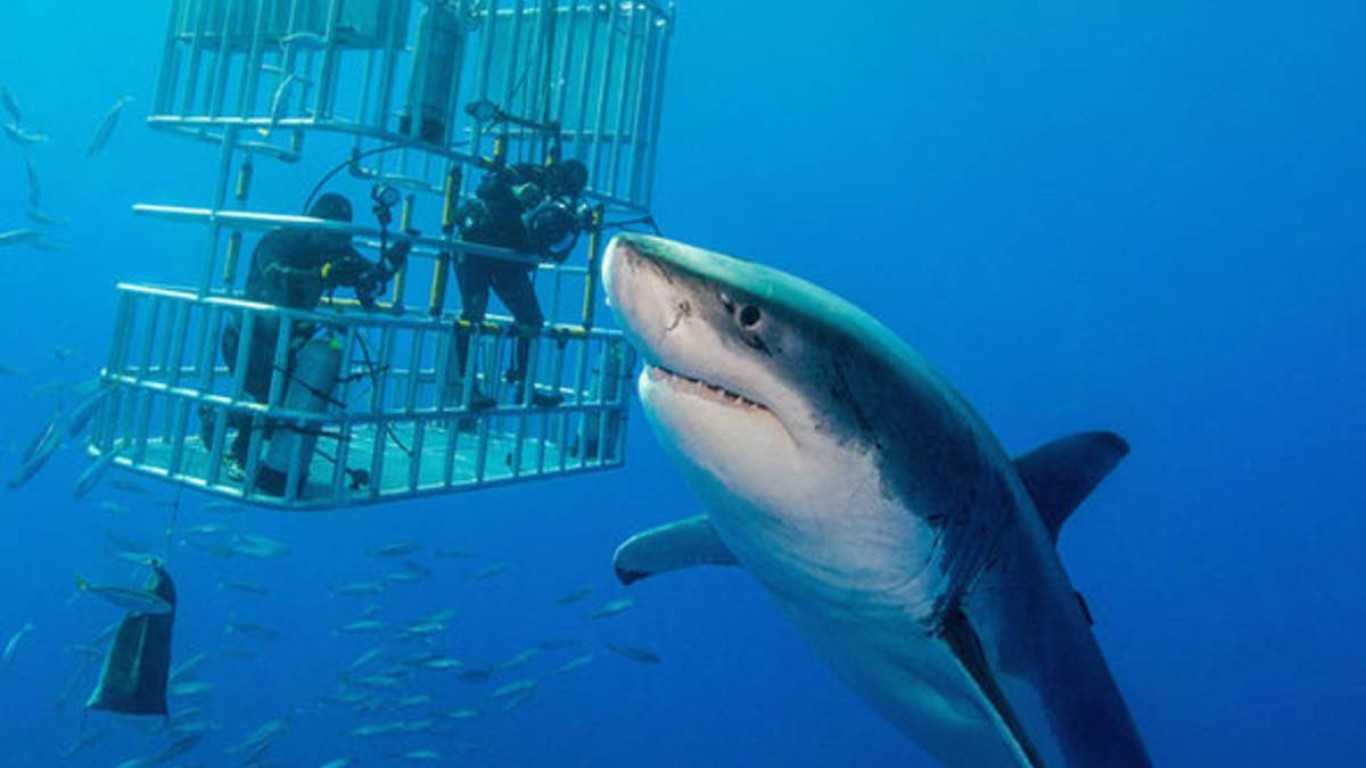
A great white shark is in the water below you. You have seen photographs, you have watched the documentaries, you have accepted intellectually that 3.5 metres of apex predator is within touching distance of the cage you are submerged in. None of that preparation is fully adequate. The animal is bigger than you expected, faster than you expected, and more present — the yellow eye, the unhurried assessment, the turn away — than any screen has managed to convey. This is what shark cage diving at Gansbaai delivers. It is not something you forget.
The town of Gansbaai (“Goose Bay” in Afrikaans) sits on the Overberg coast of the Western Cape, roughly 170 km southeast of Cape Town, beside Walker Bay. Two kilometres offshore, between Dyer Island and Geyser Rock, lies Shark Alley — a narrow channel that is considered to have the highest recorded density of great white sharks in the world, attracted and sustained by the 60,000-strong Cape fur seal colony on Geyser Rock.
How it works
Cage diving operations depart from Gansbaai harbour each morning. The boat anchors at Shark Alley and deploys a surface cage — a steel frame hanging off the boat’s side, open at the top, submerged to about 1.5 metres. Participants in wetsuits stand in the cage and dip their heads below the surface when the guide signals a shark approaching. The cage holds 4–8 people; participants rotate in and out throughout the session.
No diving certification is required for the surface cage. Scuba diving certification is required for the deeper cage experience offered by some operators.
What to expect: the honest version
Great white sharks are wild animals and sightings are never guaranteed. Most trips encounter multiple sharks; some trips see none. Operators typically run the trip over a full morning session (3–4 hours at the site) to maximise encounter probability. Cage diving is not scuba diving: you are holding your breath in a dipping cage, not swimming freely — the experience is exhilarating but brief per submersion.
The sea state matters. Gansbaai can be rough — many visitors experience seasickness on the crossing. Take motion sickness medication if you are susceptible and eat lightly before departure.
The conservation dimension
Reputable cage diving operators are actively involved in great white shark research: tagging, population monitoring and advocacy against shark culling. Marine Dynamics, White Shark Africa and Shark Bookings are among the most conservation-credentialed operators. Choosing an operator that employs qualified marine biologists on board and uses cage diving revenue to fund research is both a quality experience and a genuine conservation contribution.
The Dyer Island African penguin colony
The boat trip to Shark Alley passes Dyer Island, home to a significant African penguin colony — a bonus wildlife encounter that most cage diving descriptions undersell. In winter, kelp beds around the island also attract black-browed albatross from their Subantarctic breeding grounds.
Combine cage diving with…
- Hermanus whale watching — 20 km east; the world’s best land-based whale watching, June–December.
- Cape Town — 2 hours west; the classic day trip from the city.
- Garden Route — continue east for the coastal road trip.
Frequently asked questions about shark cage diving
Is cage diving with great white sharks safe?
Cage diving has an excellent safety record. The cage provides a physical barrier; sharks attracted by bait are focused on the surface decoy, not the people in the cage. Following the operator’s instructions precisely is the primary safety requirement.
Does cage diving make sharks more aggressive?
This is a contested question in the marine biology community. Responsible operators argue that the sharks they attract are primarily interested in bait and that no conditioning toward humans occurs. Critics disagree. The debate is ongoing; choose operators who participate transparently in the research conversation.
Do you need to be able to swim for cage diving?
No — the cage is suspended with your feet on the bottom and your head below the waterline. You do not swim; you hold the cage bars and look forward. Basic water comfort is all that’s needed.
Want to visit Cage Dive with Great White Sharks?
Get a free custom safari plan within 24 hours.
Cage Dive with Great White Sharks safari tours
No fixed packages listed yet — we'll build a custom safari around Cage Dive with Great White Sharks for you.
Browse All ToursWant to visit Cage Dive with Great White Sharks?
Get a free custom safari plan within 24 hours.
Best time for great white shark cage diving
April to October — Peak season (highest shark activity)
The Cape winter and shoulder months are the prime cage diving window. Cold, nutrient-rich upwelling water during this period triggers maximum shark activity around Dyer Island. The sharks are most frequently breaching (leaping clear of the water) in winter, particularly when hunting seals at the surface. This is when the dramatic aerial breach photography most commonly occurs. Water visibility is variable but shark encounter rates are at their annual peak.
June to December — Whale combination season
This window overlaps perfectly with the southern right whale calving season in Walker Bay near Hermanus (20 km east of Gansbaai). Combining cage diving in the morning with whale watching in the afternoon is one of South Africa’s finest wildlife day programmes.
November to March — Summer (still good, slightly lower encounter rates)
Great whites are present year-round — no season gives zero encounters. Summer water temperatures rise slightly and encounter rates may be marginally lower than the winter peak, but cage diving operators run successful trips year-round.
Bottom line: April to October for the best overall great white activity. June to November to combine with whale watching at Hermanus.
Where to stay in Cage Dive with Great White Sharks
We'll recommend accommodation across all budget levels based on your dates and preferences.
Browse All LodgesWant to visit Cage Dive with Great White Sharks?
Get a free custom safari plan within 24 hours.
Nearby destinations
 South Africa
 South Africa
 South Africa
 South Africa