
Quick facts
Wildlife
The Drakensberg is birding rather than Big Five territory. The bearded vulture (lammergeier) is the flagship species — one of the few South African populations is resident in the high Berg. Cape vulture, black eagle (Verreaux's eagle), jackal buzzard and rock kestrel are common on the escarpment. Ground-level mammals include eland (Africa's largest antelope, resident in the subalpine zone), baboon, klipspringer, mountain reedbuck and grey rhebok. Leopard are present but rarely seen. The endangered Cape parrot inhabits the remnant podocarpus forest patches.
Top activities
Cathedral Peak hiking — multi-day hut-to-hut trails from the iconic Cathedral Peak formation. Royal Natal National Park Amphitheatre walk — to the base of the 5 km escarpment wall at 3,000m. Tugela Falls approach hike — Africa's highest waterfall (948m, world's second highest) visible from the escarpment lip. Sani Pass 4WD drive to the Lesotho border at 2,873m — the highest tarred road pass in South Africa. Giant's Castle Game Reserve for bearded vulture and Bushman rock art. Rock art site visits — over 35,000 individual paintings documented in the greater Drakensberg. Fly fishing in mountain streams.
About The Drakensberg, KwaZulu-Natal
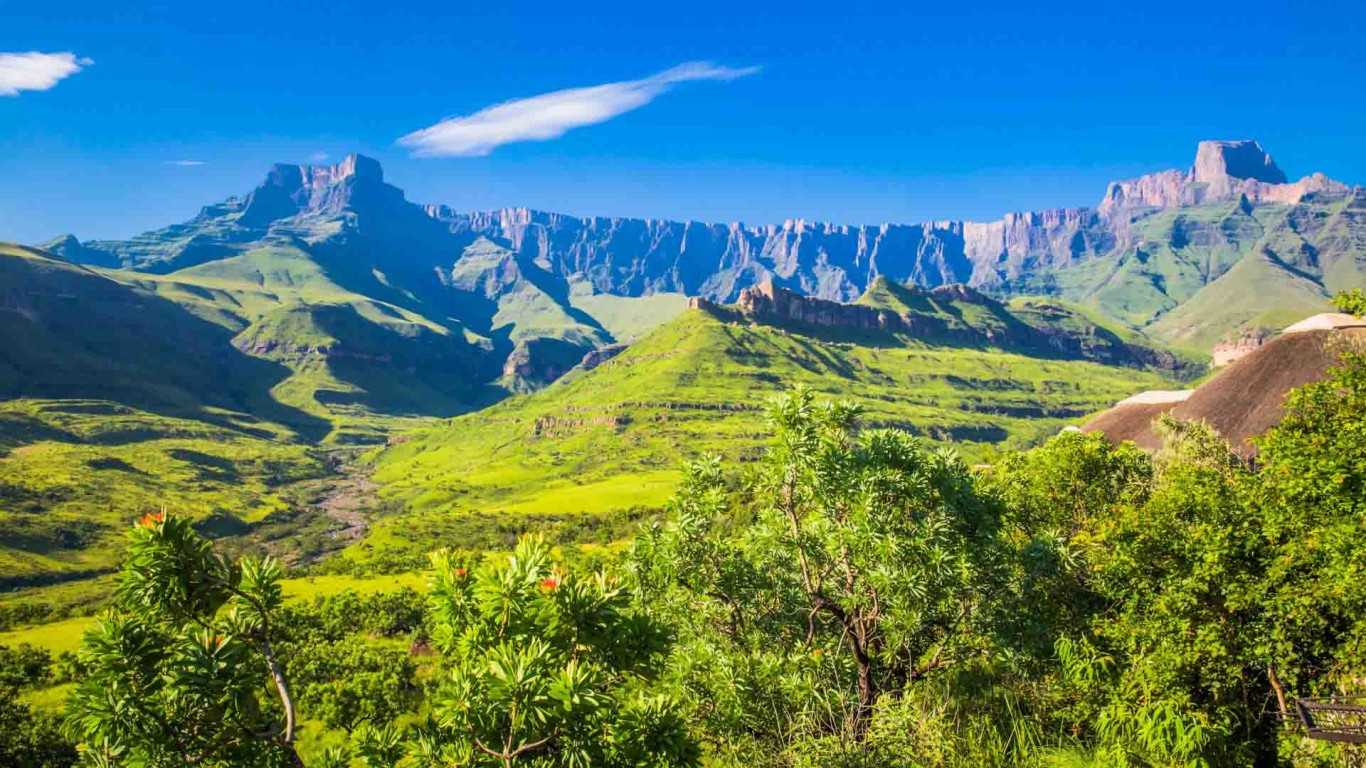
The Zulu name is uKhahlamba — “Barrier of Spears.” The Afrikaans is Drakensberg — “Dragon Mountain.” Both names describe a landscape that earns its metaphors: a 200-kilometre basalt escarpment rising to over 3,400 metres along the border of KwaZulu-Natal and Lesotho, with sheer cliff faces, buttresses and pinnacles that do genuinely resemble the spined back of a dragon when seen against a storm sky.
The Drakensberg is South Africa’s highest mountain range and one of its most extraordinary landscapes. A UNESCO World Heritage Site since 2000 (under the name uKhahlamba-Drakensberg Park), it protects not only the scenery but the world’s largest concentration of San (Bushman) rock art — over 35,000 individual paintings in more than 500 sites, created over at least 4,000 years by the continent’s earliest inhabitants.
Where is the Drakensberg?
The Drakensberg occupies the western interior of KwaZulu-Natal Province, running from Royal Natal National Park in the north to the Eastern Cape border in the south. The main access towns are Bergville (northern Berg), Winterton (central, Cathedral Peak area) and Underberg (southern Berg and Sani Pass). From Durban: 3–4 hours by road depending on the section. From Johannesburg: 4–5 hours.
Key areas
Royal Natal National Park — The Amphitheatre
The northern Berg’s centrepiece: a 5-kilometre curved cliff face reaching 3,000 metres, called the Amphitheatre for its theatrical scale. The Tugela River begins here and drops 948 metres in a series of five falls — making the Tugela Falls the world’s second highest waterfall. The valley floor day walk to the base of the Amphitheatre is one of South Africa’s finest and most accessible hikes.
Cathedral Peak
The central Berg’s landmark formation — a distinctive single spire visible for miles and the base for the region’s most varied hiking circuit. The Cathedral Peak Hotel (one of South Africa’s most historic mountain hotels) has been operating here since 1939 and remains the area’s most complete base.
Giant’s Castle
Two things bring visitors specifically to Giant’s Castle: the bearded vulture (lammergeier) hide — where a “vulture restaurant” (bait site) allows photography from a hide of one of South Africa’s most spectacular birds — and the excellent Main Cave Bushman rock art site, with guided interpretation of hundreds of paintings.
Sani Pass
A dramatic 4WD-only mountain pass in the southern Berg that climbs from KwaZulu-Natal into Lesotho at 2,873 metres — the highest tarred road pass in southern Africa. The views from the top are extraordinary. The Sani Mountain Lodge at the summit is famous for being the highest pub in Africa.
San Bushman rock art
The Drakensberg’s San rock art is among the finest in the world — not just in quantity but in quality and preservation. The paintings depict animals (eland above all, in their religious context as spirit animals), hunting scenes, rain-making ceremonies and the trance experiences of shamans. The Giant’s Castle Main Cave, the Battle Cave in Injisuthi and the Kamberg rock art centre (with interpretive exhibits) are the most accessible and best-explained sites.
Combine the Drakensberg with…
- iSimangaliso Wetland Park — mountains and coast in one KwaZulu-Natal trip.
- Durban — 3 hours east for the coast and urban culture.
- Kruger — a complete South Africa circuit: Drakensberg–Kruger–Cape Town.
Frequently asked questions about the Drakensberg
Can beginners hike in the Drakensberg?
Yes — there is a complete spectrum from easy valley walks (1–3 hours) to serious multi-day escarpment crossings. Most of the park’s most spectacular scenery is accessible on day walks from the main camp areas.
Is it safe to walk alone in the Drakensberg?
Day walks on main trails are generally safe. Lone walkers on remote trails have occasionally been mugged on certain routes near resettlement boundaries; check current safety information with camp staff before setting out.
Do you need a permit for Drakensberg rock art sites?
Some sites require a guide (Giant’s Castle Main Cave, for example) which means paying a small guided tour fee. Others are self-guided with a permit included in park entry. Check with Ezemvelo KZN Wildlife (the park authority) for site-specific requirements.
Want to visit The Drakensberg, KwaZulu-Natal?
Get a free custom safari plan within 24 hours.
The Drakensberg, KwaZulu-Natal safari tours
No fixed packages listed yet — we'll build a custom safari around The Drakensberg, KwaZulu-Natal for you.
Browse All ToursWant to visit The Drakensberg, KwaZulu-Natal?
Get a free custom safari plan within 24 hours.
Best time to visit the Drakensberg
April to October — Dry season (best for hiking)
The dry season is the prime hiking window. Trails are dry and clear, the high Berg is accessible without significant snow risk, and the plateau views are at their sharpest. Autumn (April–May) is particularly beautiful: mild temperatures, golden grasslands, clear air and the Berg almost empty of visitors after the Easter rush. Winter (June–August) brings cold nights and occasional snow on the high escarpment — exhilarating for hardy hikers. September and October warm up and the wildflowers begin.
November to January — Summer (green, dramatic storms, busy)
The Berg in summer is extraordinarily lush and green, with waterfalls at full volume. However, afternoon thunderstorms are daily and dramatic — lightning on the exposed escarpment is a real danger; plan summit attempts for the morning only. December and January school holidays make this the busiest period.
February to March — Late summer (still lush, quieter)
Storms continue but crowds thin after January. The vegetation is still at maximum green. A surprisingly rewarding and quiet window if you are happy to hike in the mornings and shelter in the afternoon.
Bottom line: April to October for the finest hiking. November to January for lush landscapes and full waterfalls, but with afternoon storm risk.
Where to stay in The Drakensberg, KwaZulu-Natal
We'll recommend accommodation across all budget levels based on your dates and preferences.
Browse All LodgesWant to visit The Drakensberg, KwaZulu-Natal?
Get a free custom safari plan within 24 hours.
Nearby destinations
 South Africa
 South Africa
 South Africa
South Africa
South Africa