
Quick facts
Wildlife
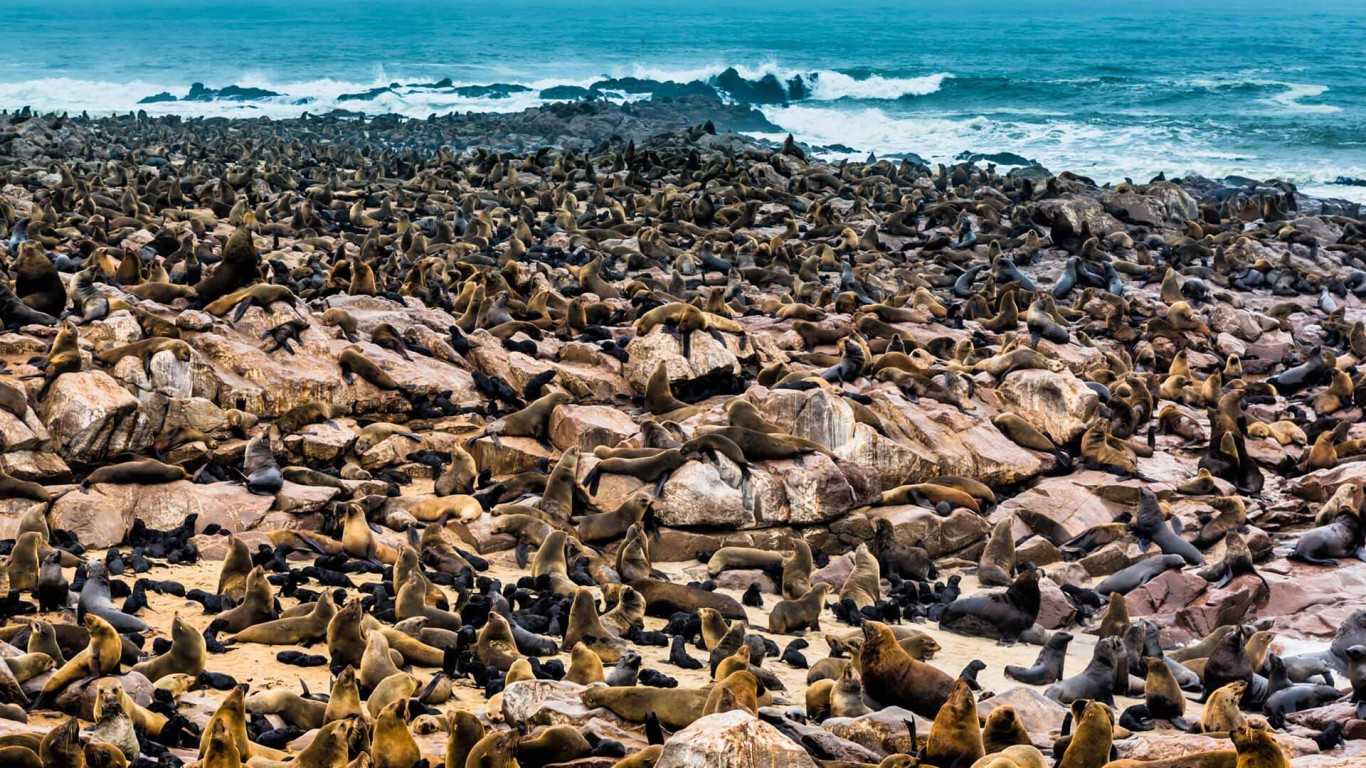
Cape Cross hosts one of the world's largest breeding colonies of Cape fur seal, with populations ranging from 80,000 to 200,000 depending on the season. The November–December breeding season sees pups being born across the beach in their thousands. Mothers and pups communicate through distinctive calls in the cacophony. Brown hyena, black-backed jackal and black-backed gulls patrol the colony edges scavenging. Black cormorant and Cape cormorant roost on the nearby rocks. The cold Benguela Current offshore makes Cape Cross one of Namibia's best offshore bird watching points for albatross, petrel and gannet.
Top activities
Seal colony observation — walking the elevated boardwalk above the beach, watching the colony from close proximity. Photography of nursing mothers, fighting bulls and scrambling pups. Historical monument visit — the Diogo Cão cross replica (the original is in Berlin's Ethnological Museum), marking the 1486 landing of the first European to reach Namibia's coast. Offshore seabird watching from the reserve's northern end. Combination day trip from Swakopmund with Welwitschia Plains (ancient desert plants) and the Skeleton Coast. Brown hyena and jackal scanning along the colony perimeter at dawn.
About Cape Cross
There are wildlife experiences that assault the senses simultaneously — sight, sound and smell arriving in one overwhelming package. Cape Cross Seal Reserve is emphatically one of them. At peak breeding season (November–December), up to 200,000 Cape fur seals pack a 4 km stretch of beach on Namibia’s Skeleton Coast. The noise — a continuous roar of barking, bleating, territorial bellowing — is audible a kilometre away. The smell, generated by an estimated 100 tonnes of sea mammals and their associated organic output, arrives somewhat before the sound.
And yet Cape Cross is one of the most compelling wildlife destinations in southern Africa. The scale of the colony is simply staggering; the behaviour — bulls fighting for territories, mothers locating specific pups by call in the apparent chaos, pups scrambling over each other toward their mothers — is endlessly fascinating. This is one of the largest concentrations of mammals anywhere on the planet.
Where is Cape Cross?
Cape Cross is 120 km north of Swakopmund along the C34 coastal road, at the southern edge of the Skeleton Coast National Park. The reserve is a day trip from Swakopmund (2 hours each way); the road is sealed and in good condition.
The Diogo Cão cross
The reserve takes its name from the large stone cross erected here in 1486 by Portuguese explorer Diogo Cão — who was the first European to land on what is now Namibia’s coastline. The original cross was removed by German colonists in 1893 and taken to the Ethnological Museum in Berlin, where it remains. The current monument at Cape Cross is a precise replica. It marks one of the key waypoints in the European Age of Exploration and the beginning of the European contact with southern Africa’s west coast.
The seal colony up close
A raised boardwalk runs along the colony edge, allowing visitors to observe the seals from 2–5 metres without disturbing the animals. The boardwalk ends at a viewing platform over the beach. Photography from here is excellent — the seals largely ignore visitors, allowing extended behavioral observation. The colony density closest to the parking area is the highest; walking the boardwalk to its northern end reveals quieter sections where the interaction between bulls and pups is less frantic.
Brown hyena and jackal
The colony perimeter is hunted by brown hyena (a species rarely seen in most southern African parks) and black-backed jackal, both scavenging dead pups and opportunistically taking live ones. Dawn drives along the colony perimeter can produce excellent brown hyena sightings — one of the best locations in Namibia for this elusive species.
Combine Cape Cross with…
- Swakopmund — the base town, 2 hours south.
- Skeleton Coast National Park — continue north for the dramatic desert coastline.
- Welwitschia Plains — the ancient Welwitschia plants (2,000+ years old) on the drive north from Swakopmund.
Frequently asked questions about Cape Cross
Is the smell really that bad?
Yes, particularly in breeding season when the colony is at maximum density and the sun is overhead. Arrive in the morning before midday heat intensifies the odour and stay upwind of the densest sections. It is the price of admission to one of the world’s great wildlife spectacles.
Can you go onto the beach with the seals?
No — access is from the boardwalk only. Entering the colony area is prohibited.
How long should you spend at Cape Cross?
One to two hours is enough for a complete boardwalk walk and photography. Combined with the Welwitschia Plains, it makes a full-day Swakopmund excursion.
Want to visit Cape Cross?
Get a free custom safari plan within 24 hours.
Cape Cross safari tours
Want to visit Cape Cross?
Get a free custom safari plan within 24 hours.
Best time to visit Cape Cross
November to December — Breeding season (peak colony experience)
The breeding season is the most spectacular period. Bull fur seals establish territories in October; pups are born from late November through December. The beach is at maximum capacity — up to 200,000 animals, the noise and smell are formidable, and the sight of hundreds of newborn pups among the colony is extraordinary. The Skeleton Coast fog keeps temperatures manageable (15–20°C).
January to March — Pup season (pups active and growing)
The pups born in November are now growing rapidly — playing, fighting for nursing access and beginning to test the water. The colony is still at high occupancy. Bulls maintain their territories. An active and entertaining period.
May to October — Year-round colony (fewer animals, cooler, better smell)
Outside breeding season the colony is smaller but still impressive, with tens of thousands of seals present at all times. Temperatures are cooler and the colony odour is less intense. A more comfortable visit for those sensitive to the breeding season’s formidable aromatic environment.
Bottom line: November to January for the full breeding spectacle. Year-round for the colony; seals are always present.
Where to stay in Cape Cross
We'll recommend accommodation across all budget levels based on your dates and preferences.
Browse All LodgesWant to visit Cape Cross?
Get a free custom safari plan within 24 hours.
Nearby destinations
 Namibia
 Namibia
 Namibia
Namibia
Namibia
 Namibia