
Quick facts
Wildlife
Fish River Canyon supports desert-adapted species throughout its depth. Hartmann's mountain zebra, kudu, leopard, baboon, klipspringer and dassie (rock hyrax) inhabit the canyon walls. Caracal and black-backed jackal roam the plateau above. Lappet-faced vulture, booted eagle and Pale Chanting Goshawk are commonly seen on the canyon rim. The canyon floor trail encounters kudu, baboon and the occasional Hartmann's zebra. The Fish River itself, reduced to a series of pools in the dry season, supports catfish, Nile crocodile (rare in this section) and abundant waterbirds.
Top activities
Fish River Canyon hiking trail (5 days, 85 km, May–September only) — one of Africa's classic multi-day hikes from Hobas to Ai-Ais hot springs. Canyon rim viewpoint drive from Hobas camp — multiple viewpoints along the 10 km rim road. Hobas viewpoint dawn visit — the canyon turns red-gold in morning light. Ai-Ais Hot Springs Resort — thermal springs at the canyon's southern end, the traditional hike finish point. 4WD desert drive through the Gondwana Cañon Park conservancy. Photography from Hiker's Viewpoint — the most dramatic single canyon vista. Combination road trip with Sossusvlei and Lüderitz/Kolmanskop.
About Fish River Canyon
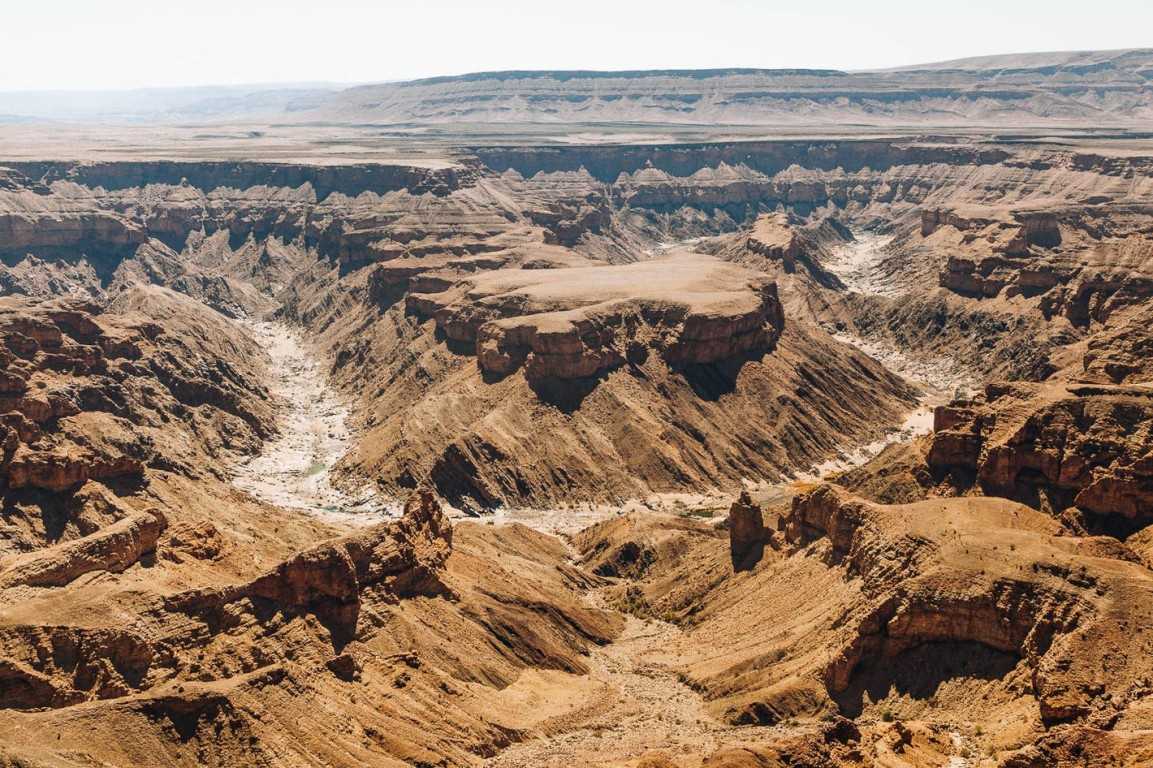
If the Grand Canyon is America’s geological masterpiece, Fish River Canyon is Africa’s. At 160 km long, up to 27 km wide and 550 metres deep, it is the world’s second-largest canyon — and unlike the Grand Canyon, it has relatively few visitors, no shuttle buses, no guardrails and a 5-day hiking trail along the canyon floor that is widely considered one of Africa’s finest long-distance walks.
The canyon was carved over 600 million years by the Fish River, the longest river entirely within Namibia. The geological layers exposed in the walls read as an archive of southern Africa’s ancient history: basement granite over a billion years old at the bottom, sedimentary layers above recording ancient seas and inland basins, capped by the more recent desert plateau. It is, in the most literal sense, deep time made visible.
Where is Fish River Canyon?
Southern Namibia, approximately 170 km north of the Orange River (South African border). The main visitor infrastructure is at Hobas Camp on the canyon rim and Ai-Ais Hot Springs Resort at the southern end. From Windhoek: 760 km, approximately 8–9 hours. From Keetmanshoop (the nearest town with accommodation): 130 km, 1.5 hours.
The canyon hike
The Fish River Canyon Hiking Trail runs 85 km along the canyon floor from Hobas to Ai-Ais over 5 days, following the Fish River as it winds between the canyon walls. It is an unguided, unsupported trail — no huts, no water except the river pools, no trail crew — which makes it considerably more serious than most African multi-day walks. Requirements:
- Minimum group of 3 people (solo hiking not permitted).
- A doctor’s certificate of fitness (issued within 40 days of the hike).
- Permit from NWR (Namibia Wildlife Resorts), bookable online.
- Season: May 1 to September 15 only.
The terrain alternates between rocky river bed, pools requiring wading, and sand banks. Water is from the river and must be treated. The final day ends at the Ai-Ais hot springs, where hikers traditionally soak in the thermal pools for an hour before the transfer back to Hobas.
The rim viewpoints
For non-hikers, the canyon rim road at Hobas provides a series of viewpoints over the canyon. The Main Viewpoint and Hiker’s Viewpoint (where you can look down the full depth of the canyon to the river 550 metres below) are the most dramatic. Sunrise from the Main Viewpoint, when the canyon walls turn from grey to terracotta to gold in sequence, is worth setting an alarm for.
Ai-Ais Hot Springs
At the canyon’s southern end, the Ai-Ais Hot Springs Resort (the name means “scalding hot” in the Nama language) has natural thermal pools at 60°C cooled to swimable temperature, chalets, camping and a restaurant. It is a destination in itself for Namibian holidaymakers and the logical end point of the canyon hike.
Combine Fish River Canyon with…
- Kolmanskop and Lüderitz — the southern Namibia coastal circuit.
- Sossusvlei — continue north for the Namib dune sea.
- Gondwana Cañon Park — the private conservancy adjacent to the canyon with guided drives and accommodation.
Frequently asked questions about Fish River Canyon
How difficult is the Fish River Canyon hike?
Strenuous. The terrain is rough, distances are long (up to 25 km per day) and conditions are exposed. No technical skills are needed but strong fitness, blister management, and heat regulation experience are essential. Many hikers consider it the hardest non-technical trail they’ve done.
Is Fish River Canyon bigger than the Grand Canyon?
It is the world’s second-largest canyon but the Grand Canyon is larger in depth (1,857 m vs 550 m) and volume. Fish River Canyon is longer (160 km vs 446 km of the Grand Canyon gorge) and considerably wider in places.
Can you see Fish River Canyon without hiking?
Yes — the rim viewpoints are accessible to all visitors and are genuinely dramatic without any hiking. Day visitors without accommodation bookings are welcome at the Hobas viewpoints.
Want to visit Fish River Canyon?
Get a free custom safari plan within 24 hours.
Fish River Canyon safari tours
Want to visit Fish River Canyon?
Get a free custom safari plan within 24 hours.
Best time to visit Fish River Canyon
May to September — Dry season / winter (hiking season and comfortable visits)
The only season when the canyon hike is permitted. Temperatures on the canyon floor in summer can exceed 50°C — a genuine survival risk — so the trail is officially closed from October through April. The dry season (May–September) brings temperatures of 20–30°C on the floor, cold nights (0–5°C) and the most reliable conditions for the 5-day trek. Rim viewpoint visits are comfortable year-round in winter.
June to August — Peak hiking months
The coolest and most popular hiking window. The dry river bed contains a chain of pools that provide water sources along the route (critical for planning). Morning light on the canyon from the Hobas viewpoints is at its most dramatic in the clear winter sky.
October to April — Summer (viewpoints only, no hiking)
The rim viewpoints are accessible and dramatic in summer, with afternoon thunderstorm clouds building over the canyon creating extraordinary light. The canyon floor hike is strictly prohibited due to lethal temperatures.
Bottom line: May to September for the hike. Year-round for viewpoint visits. June and July for the finest combination of hiking conditions and winter scenery.
Where to stay in Fish River Canyon
We'll recommend accommodation across all budget levels based on your dates and preferences.
Plan My Trip Browse All LodgesWant to visit Fish River Canyon?
Get a free custom safari plan within 24 hours.
Nearby destinations
 Namibia
 Namibia
 Namibia
 Namibia
 Namibia