
Quick facts
Wildlife
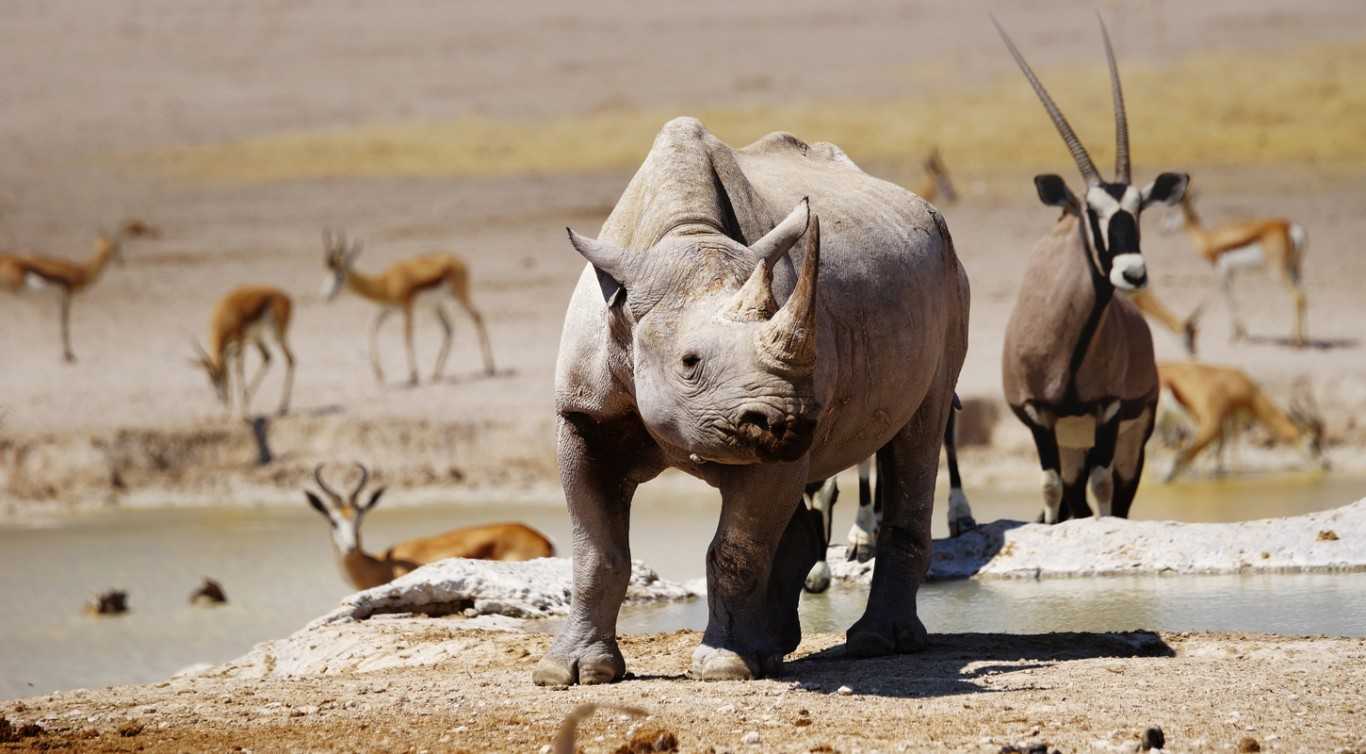
Twyfelfontein is surrounded by Namibia's Damaraland region, one of the best areas in Africa for desert-adapted species. Desert-adapted elephant (a genetically distinct population adapted to go days without water) are present in the wider Huab and Ugab river systems. Black rhino inhabit the rocky terrain around Twyfelfontein — one of the few free-roaming black rhino populations in the world outside a fenced reserve. Mountain zebra, oryx, springbok, ostrich and klipspringer are common. Cheetah are present. The area has excellent raptor watching including Verreaux's eagle and Lanner falcon on the sandstone cliffs.
Top activities
Guided rock engraving tour at Twyfelfontein UNESCO site — all visitors must use a Namibia Wildlife Resorts or local Damara guide; 1-2 hours on the site trail. The Petrified Forest — 260-million-year-old fossilised tree trunks from an ancient Antarctica-climate forest, 40 km west near Khorixas. The Organ Pipes — columnar basalt formations from volcanic intrusion exposed by erosion, 3 km from Twyfelfontein. Desert-adapted elephant tracking (guided, morning) in the Huab River valley. Black rhino tracking with Save the Rhino Trust rangers (advance booking). Damaraland scenic drive through red sandstone landscapes to Brandberg Mountain.
About Twyfelfontein
In a valley in Damaraland, northwestern Namibia, a spring seeps from red sandstone rock. It is called Twyfelfontein — “Doubtful Spring” in Afrikaans — because the early European settler who named it was uncertain whether it would be reliable enough to support livestock. For the San hunter-gatherers who used the site over thousands of years, the spring had no such doubts: it was a fixed point in an otherwise waterless landscape, and around it they gathered and, generation after generation, carved their knowledge and beliefs into the red sandstone.
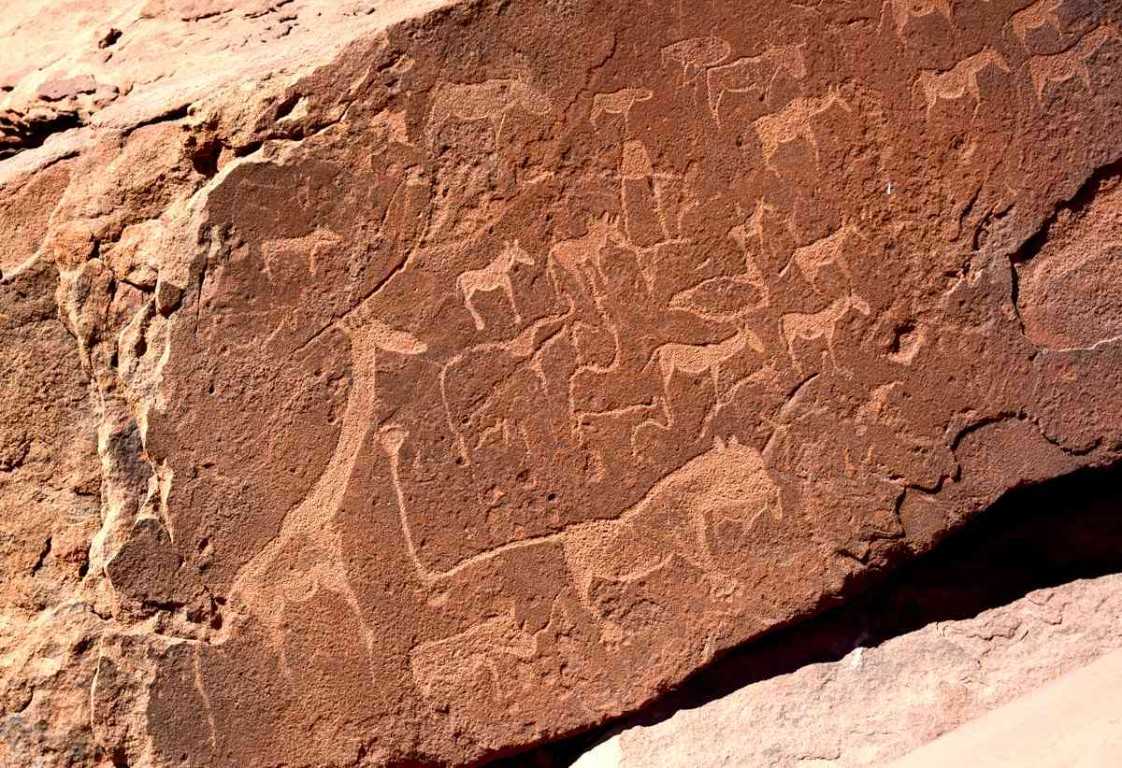
The result is Africa’s largest single concentration of rock engravings: over 2,500 petroglyphs carved into the tilted sandstone slabs around the spring, depicting lion, elephant, rhino, giraffe, zebra, oryx, sea lions (remarkable given the distance from the ocean), human footprints, and abstract geometric forms associated with shamanic trance states. The site was inscribed as a UNESCO World Heritage Site in 2007.
Where is Twyfelfontein?
The site is in the Kunene Region of northwestern Namibia, 70 km north of Khorixas via the C39 road. From Swakopmund: 290 km northeast on the C34 and C39, approximately 4 hours. From Etosha (Okaukuejo): 320 km south, 4 hours. The access road is gravel and passable in 2WD with care.
The rock engravings
The engravings at Twyfelfontein are petroglyphs rather than paintings — made by cutting through the red-brown surface oxidation of the sandstone to reveal the lighter rock below. They were created over a period of approximately 6,000 years by San hunter-gatherers for whom the site was a sacred gathering place. The imagery includes:
- Animal tracks — lion spoor, rhino footprints, elephant prints recorded with a precision that suggests ritual hunting knowledge.
- The dancing kudu — a group of kudu in what appears to be a dance formation, one of the site’s most frequently reproduced images.
- Sea lions — engraved 120 km from the Atlantic, indicating the San’s wide-ranging movement through the Namib.
- The shaman — a therianthropic figure (half-human, half-animal) that in San belief represented a shaman in trance, able to enter the spirit world of the animals.
A licensed guide is mandatory at the site and genuinely enhances the visit — the iconography is complex and the interpretive context (San cosmology, the shamanic worldview, the relationship between the spring and the site) transforms what would otherwise be an impressive collection of marks into a coherent and moving record of human spiritual life.
The Petrified Forest
Forty kilometres west of Twyfelfontein near Khorixas, the Petrified Forest preserves 260-million-year-old fossilised tree trunks — remnants of a forest that grew during the Permian period when what is now Namibia had a cool, wet climate similar to Antarctica. Silicification (replacement of organic material by silica) preserved the logs in extraordinary detail: wood grain, bark texture and growth rings are all visible in stone. The site is managed as a national monument; a local guide leads a 1-hour walk among the logs.
The Organ Pipes
Three kilometres from Twyfelfontein, The Organ Pipes are a 100-metre section of columnar basalt — formed when volcanic lava intruded into existing rock and cooled slowly, contracting into the characteristic hexagonal columns. Subsequent erosion has exposed the formation along the base of a small canyon. The columns range from 4–6 metres in height and are immediately recognisable as the same geological process that created Iceland’s Fingal’s Cave and Antrim’s Giant’s Causeway.
Desert-adapted elephant and black rhino
The Damaraland landscape surrounding Twyfelfontein is home to two of Namibia’s conservation prizes: desert-adapted elephant and free-roaming black rhino. The desert elephant of the Huab and Ugab river systems are not a separate species but a genetically distinct population adapted to survive without water for up to 4 days — longer than any other elephant population. Black rhino tracking with Save the Rhino Trust rangers (advance booking required through local lodges) is one of Namibia’s finest wildlife experiences.
Combine Twyfelfontein with…
- Spitzkoppe — another San rock art site, 3–4 hours south.
- Etosha National Park — 4 hours northeast; the Namibia wildlife circuit.
- Swakopmund — 4 hours southwest; the coastal base.
- Brandberg Mountain — Namibia’s highest peak, 2 hours south, with more San rock art and the famous White Lady painting.
Frequently asked questions about Twyfelfontein
Can you visit Twyfelfontein without a guide?
No — a licensed guide is mandatory and the fee is included in the site entrance. This is both a conservation measure and a genuine enhancement — the engravings are cryptic without interpretation.
How long does the Twyfelfontein visit take?
The standard guided walk takes 60–90 minutes. Combining with the Petrified Forest and Organ Pipes makes a full half-day programme.
What is the difference between rock engravings and rock paintings?
Engravings (petroglyphs) are cut into the rock surface; paintings use pigment applied to the surface. Twyfelfontein has engravings. The Drakensberg in South Africa and Namibia’s Brandberg Mountain have paintings. Both are San in origin but use different techniques and often different iconographies.
Want to visit Twyfelfontein?
Get a free custom safari plan within 24 hours.
Twyfelfontein safari tours
Want to visit Twyfelfontein?
Get a free custom safari plan within 24 hours.
Best time to visit Twyfelfontein
May to October — Dry season / winter (most comfortable, best for elephant tracking)
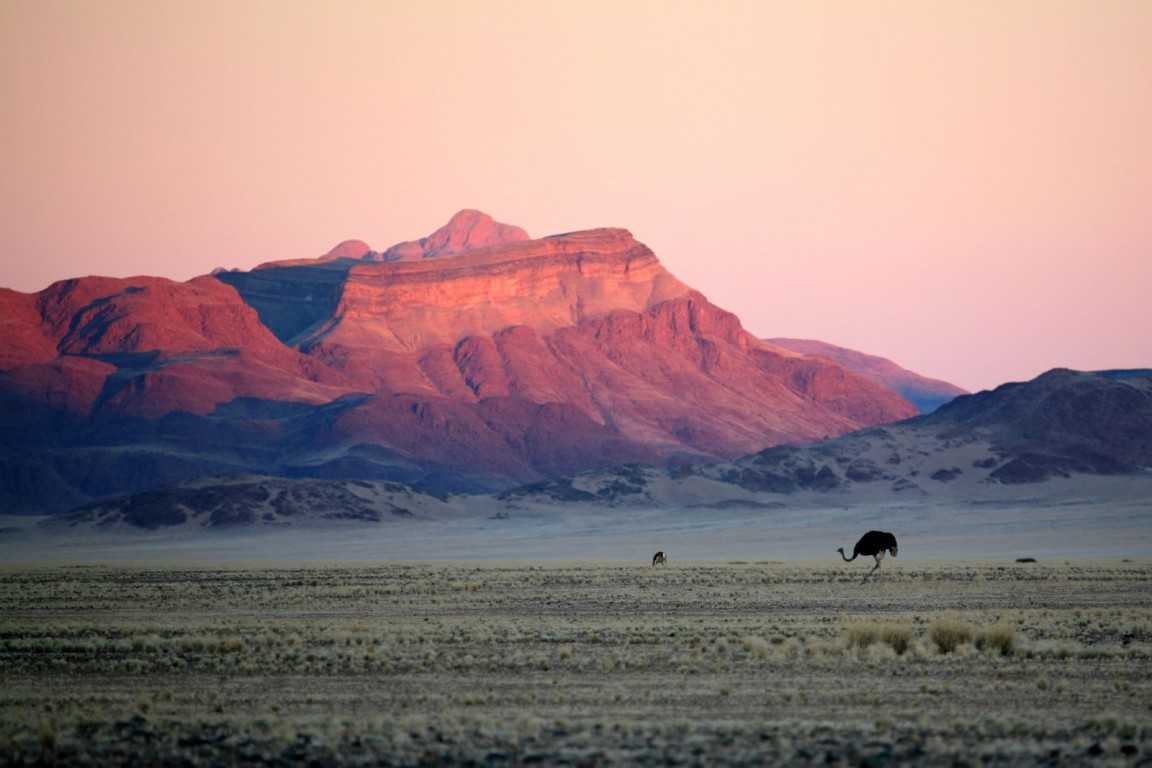
The Damaraland dry season is the most comfortable visiting window. Temperatures are 20–30°C in the day and cool at night. Desert-adapted elephant are most predictable near the Huab River bed water sources. Black rhino tracking is most productive in the dry season when the animals are tied to limited water. The rock engravings at Twyfelfontein are accessible year-round — the site quality does not vary seasonally.
November to April — Summer (hotter, occasional rain, greener Damaraland)
Summer temperatures can reach 38–42°C in the Damaraland valleys. When rain does come (rarely), the landscape transforms briefly to green — extraordinary in context. Summer elephant movements are more unpredictable as temporary water sources appear.
Bottom line: May to October for the most comfortable conditions and the best desert elephant and black rhino tracking. Year-round for the rock art site itself.
Where to stay in Twyfelfontein
We'll recommend accommodation across all budget levels based on your dates and preferences.
Plan My Trip Browse All LodgesWant to visit Twyfelfontein?
Get a free custom safari plan within 24 hours.
Nearby destinations
 Namibia
 Namibia
 Namibia
 Namibia
 Namibia